About Nihongo Kentei
What is Nihongo Kentei ( 日本語検定)?
The "Nihongo Kentei" is a Japanese language proficiency test designed primarily for native speakers, unlike the JLPT (Japanese Language Proficiency Test), which is more widely known and used by non-native learners. The Nihongo Kentei, also known as the Japanese Language Examination, has five levels, with N1 being the most advanced and N5 the most basic. It measures a broad range of Japanese language skills, including kanji, vocabulary, grammar, and reading comprehension, with a focus on understanding Japanese used in various situations.
Here's a More Detailed Breakdown (より詳細な内訳は次のとおりです):
· Focus on Native Speakers (ネイティブスピーカーに焦点を当てる): The Nihongo Kentei is designed for Japanese native speakers to evaluate their language skills across various contexts, including those requiring specialized knowledge and formal language.
· Levels (レベル): The test has five levels: N1 (highest), N2, N3, N4, and N5 (lowest).
· Content (内容): The test evaluates knowledge of kanji, vocabulary, grammar, and reading comprehension, with a focus on understanding Japanese used in everyday situations and more specialised contexts.
· Not Specifically for Foreigners ( 外国人専用ではありません): Unlike the JLPT, the Nihongo Kentei is not primarily targeted towards non-native learners of Japanese.
· Broader Range of Skills (幅広いスキル): It covers a broader range of skills than the JLPT, including keigo (honorific language) and some aspects of grammar that are more relevant to native speakers.
· Frequency ( 頻度): The test is held twice a year, in June and November.
· Large Participation (大規模な参加): Approximately 300,000 people take the Nihongo Kentei each year.
Questions in the Nihongo Kentei fall into six categories
1. 敬語 (Honorifics)
2. 文法 (Grammar)
3. 語彙 (Vocabulary)
4. 言葉の意味 (Definitions)
5. 表記 (Expressions)
6. 漢字 (Kanji)
Criteria for certification (認定基準)
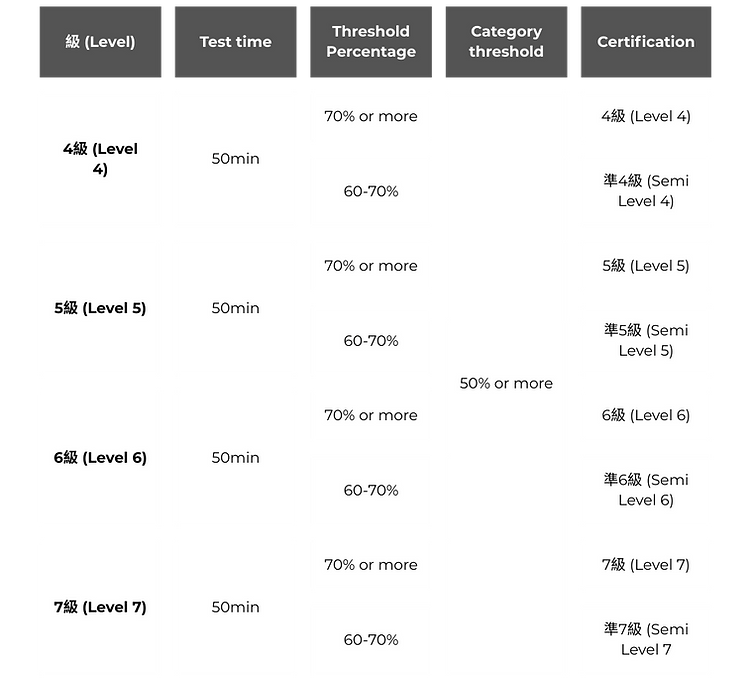
There are two types of certifications for each level, depending on the percentage scored.
Successful applicants must score more than 50% for all six categories mentioned above (shown in the table below as "category threshold"). If results in any category fall below the category threshold, the candidate will not be certified (except for the lowest category, Level 7). Note that 1級 (Level 1) refers to the best possible grade, and 7級 (Level 7) refers to the worst.